
.svg)

Lagree and Pilates: Two Methods Worth Understanding
A Shared Lineage, Different Destinations
Lagree and Pilates share more history than most people realize. The Lagree Method grew directly from the Pilates tradition. Sebastien Lagree developed his method while teaching Pilates in Los Angeles, starting in 1998. He used the Pilates reformer as his starting point and rebuilt it into something designed for a different purpose. Understanding both methods well means understanding where they share ground and where they deliberately diverge.
This is not a ranking. Both methods have genuine value. They were designed with different goals in mind, and the one that is right for you depends on what you are actually trying to accomplish. This article helps you figure that out.
What Pilates Is Designed to Do
Pilates was developed by Joseph Pilates in the early 20th century as a rehabilitative movement system. His original goal was to help injured soldiers rebuild strength and coordination in a way that was gentle on the body. The method later found a devoted following among dancers and athletes who valued its emphasis on precise, controlled movement, core engagement, and postural alignment.
Reformer Pilates uses spring resistance to support and challenge movement. The springs on a Pilates reformer are light to moderate in tension, designed to assist or gently resist movement rather than create maximum muscular load. The exercises are built around movement quality, range of motion, and the activation of specific muscles, particularly the deep stabilizing muscles of the core and spine.
The results from consistent Pilates practice are real and well-documented. Better posture. Improved flexibility. Stronger stabilizing muscles. Reduced back pain. Greater body awareness. These are the outcomes the method was designed to produce, and it delivers them. Pilates has a long and well-earned tradition in movement education and rehabilitation, and that tradition continues to benefit a wide range of people.
What Lagree Is Designed to Do
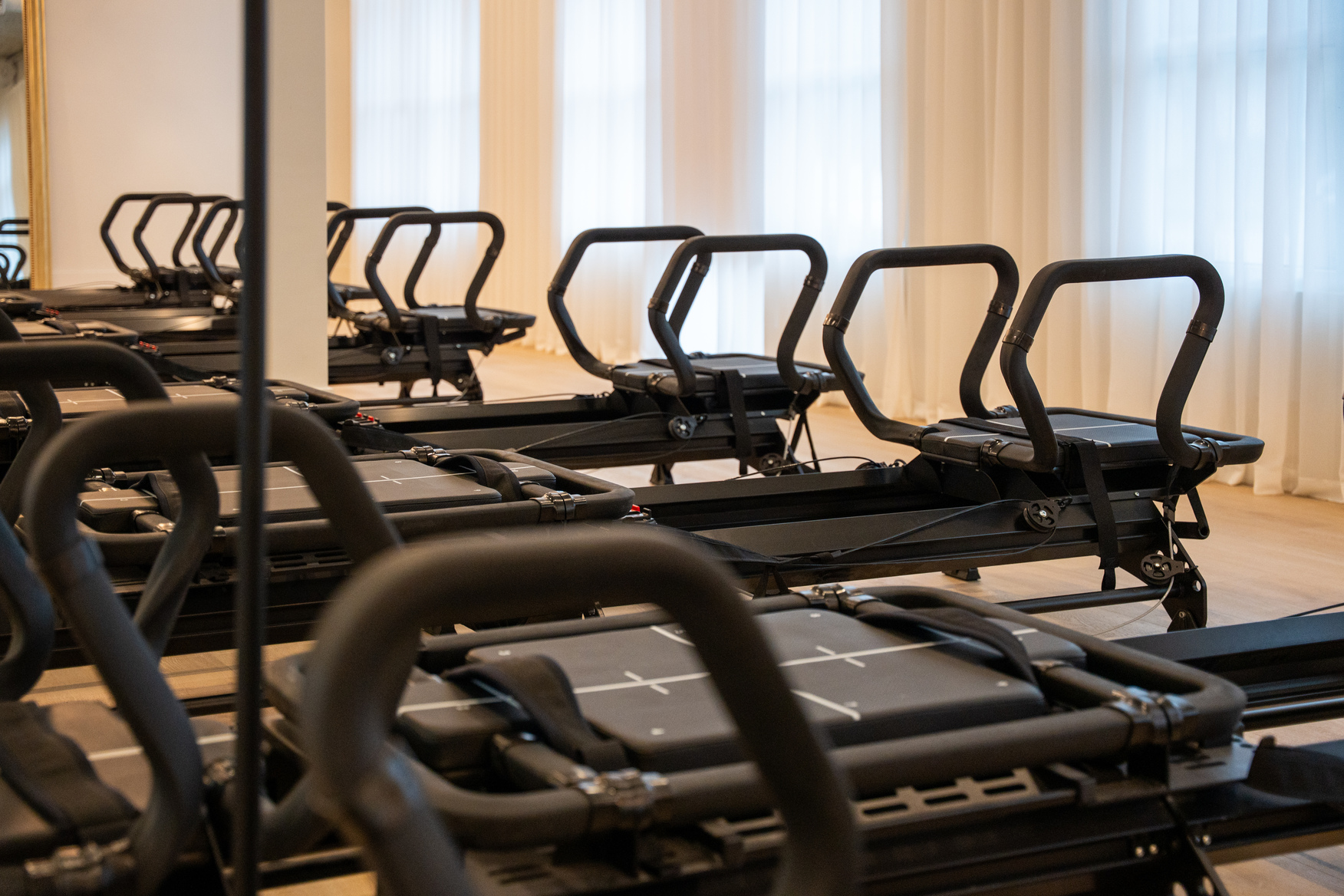
Lagree was designed with physical transformation as its explicit goal. Sebastien Lagree wanted a method that combined the structural precision of Pilates with the intensity needed to build lean muscle and produce visible changes in the body. The result was the Megaformer, a machine that applies significantly heavier spring resistance than a Pilates reformer, and the Lagree Method, which uses slow tempo and sustained effort to maximize time under tension.
Time under tension is the key principle. Muscles develop when they are loaded with enough resistance, for long enough, to create an adaptive stimulus. Lagree maximizes that variable more deliberately than almost any other training format. Sets run for 45 to 90 seconds at strict slow tempo. Two seconds in each direction, no momentum, no rest between reps. The result is a deeper and more sustained muscular demand than a Pilates class typically creates.
The physical outcomes from consistent Lagree training reflect that design. Visible muscle tone. Changes in body composition. Core strength that shows up in how you carry yourself. These are the specific things the method was built to produce.
Where They Differ in Practice
Resistance load. This is the most significant mechanical difference. Lagree uses heavier spring resistance throughout every exercise. The load is designed to create muscular fatigue within 45 to 90 seconds. Pilates uses lighter spring tension calibrated for movement assistance and precision.
Tempo. Lagree uses one tempo throughout the entire class: two seconds in each direction, with no exceptions. The slow, controlled pace removes momentum and forces the muscles to do all the work. Pilates uses a range of tempos depending on the exercise and the goal.
Time under tension. Each Lagree set is designed to keep the muscle under tension for at least 60 seconds, stimulating both slow-twitch and fast-twitch muscle fibers. Pilates exercises vary in duration and do not optimize specifically for sustained muscular load.
Goals. Pilates prioritizes movement quality, flexibility, and functional strength. It is exceptional for rehabilitation, body awareness, and long-term joint health. Lagree prioritizes muscle development, body composition change, and the kind of physical transformation that most people describe when they say they want to see real results.
Both methods are low impact. Neither involves jumping, heavy spinal loading, or repetitive joint stress. This is one of the most important things they share, and it is a significant reason both have loyal followings among people who want to train hard and stay healthy over time.
Choosing Based on Your Goals
If your primary goals are rehabilitation, flexibility, movement education, or a gentler strength practice that supports long-term joint health, Pilates is an excellent fit. The method does exactly what it was designed to do, and it does it with a precision and attention to body mechanics that rewards consistent practice.
If your primary goals are visible muscle development, body composition change, and a physically demanding workout that you can do three times a week without accumulating joint damage, Lagree is built specifically for that. The resistance loads and time under tension are calibrated to produce the adaptive stimulus that builds lean muscle and changes how the body looks and feels.
If you have been training consistently for a while and feel like you have plateaued, Lagree provides a fundamentally different stimulus than most people have experienced. That difference is often what breaks a plateau.
Many People Do Both
It is worth noting that choosing one does not mean abandoning the other. Many people in Charleston use Pilates as a recovery practice or a mobility day alongside their regular Lagree training. The methods complement each other well. Pilates builds the precise body awareness and movement vocabulary that makes Lagree more effective. Lagree builds the strength and endurance that makes every other physical activity easier.
People who come to Lagree from a Pilates background often adapt to it faster than people coming from other workout formats. They already understand controlled movement, core engagement before a movement rather than after, and the value of precision. That foundation transfers directly. The transition is less about starting over and more about turning up the dial.
The Honest Summary
Pilates is a meaningful method with a long and well-earned tradition. It has changed people's relationship with their bodies, helped them recover from injury, and given them a movement practice they have sustained for decades. That is not a small thing.
Lagree was built with a specific question in mind: what would a method look like if it were designed from the ground up to produce physical transformation through maximum time under tension and minimum joint impact? The Megaformer and the Lagree Method are the answer to that question. Both are legitimate. Both produce real results. The right choice depends entirely on what you are trying to accomplish.
About FORM Charleston
FORM is a certified Lagree Fitness studio with locations at 320 Broad Street in Downtown Charleston and 725 Coleman Boulevard in Mount Pleasant. Classes run 45 minutes on the Megaformer. New? The first-timers page on the FORM website covers everything before you book.
Book your first Lagree class at formcharleston.com.
Disclaimer: Results vary by individual. This content is for informational purposes only. Consult a healthcare professional before beginning any new fitness program.