
.svg)

Lagree vs. HIIT: What the Science Says About Which Workout Changes Your Body
Two Different Theories About How the Body Changes
HIIT has had a long run at the top of the fitness conversation. High-intensity interval training became the default answer to almost every fitness question for the better part of a decade. Short on time? HIIT. Want to lose weight? HIIT. Want to feel like you worked hard? Definitely HIIT. The format earned that reputation for real reasons. It works. But it also has limitations that do not get talked about enough, and for a growing number of people those limitations are starting to show up in their joints, their recovery time, and their plateaued results.
Lagree sits in an interesting position relative to HIIT. It is quieter about what it does. There is no jumping, no burpees, no moment where you collapse on the floor. And yet people who add Lagree to their routine, or switch to it from HIIT, consistently report physical changes that high-intensity cardio alone was not producing. This article looks at both methods honestly.
What HIIT Actually Does
High-intensity interval training alternates between periods of maximum or near-maximum effort and periods of rest or lower-intensity movement. The work intervals are short, typically 20 to 40 seconds. The rest intervals vary. The total session usually runs 20 to 45 minutes. The appeal is efficiency. Research from the early 2000s onward demonstrated that short bursts of high-intensity work could produce cardiovascular and metabolic adaptations comparable to longer steady-state cardio sessions.
The physiological mechanism behind HIIT's calorie-burning reputation is excess post-exercise oxygen consumption, or EPOC. After a high-intensity session, the body continues burning calories at an elevated rate while it recovers. This afterburn effect is real, though its magnitude is often overstated in fitness marketing. HIIT is also genuinely effective for cardiovascular conditioning: the heart and lungs adapt to repeated high-intensity work in ways that improve endurance and lower resting heart rate.
What HIIT is less effective at is building lean muscle mass. The intervals are too short and the loads are typically too light to create the sustained muscular stimulus that drives meaningful muscle development. Cardio-based HIIT burns calories during and briefly after the session, but it does not build the muscle tissue that raises your resting metabolic rate over the long term.
What Lagree Actually Does
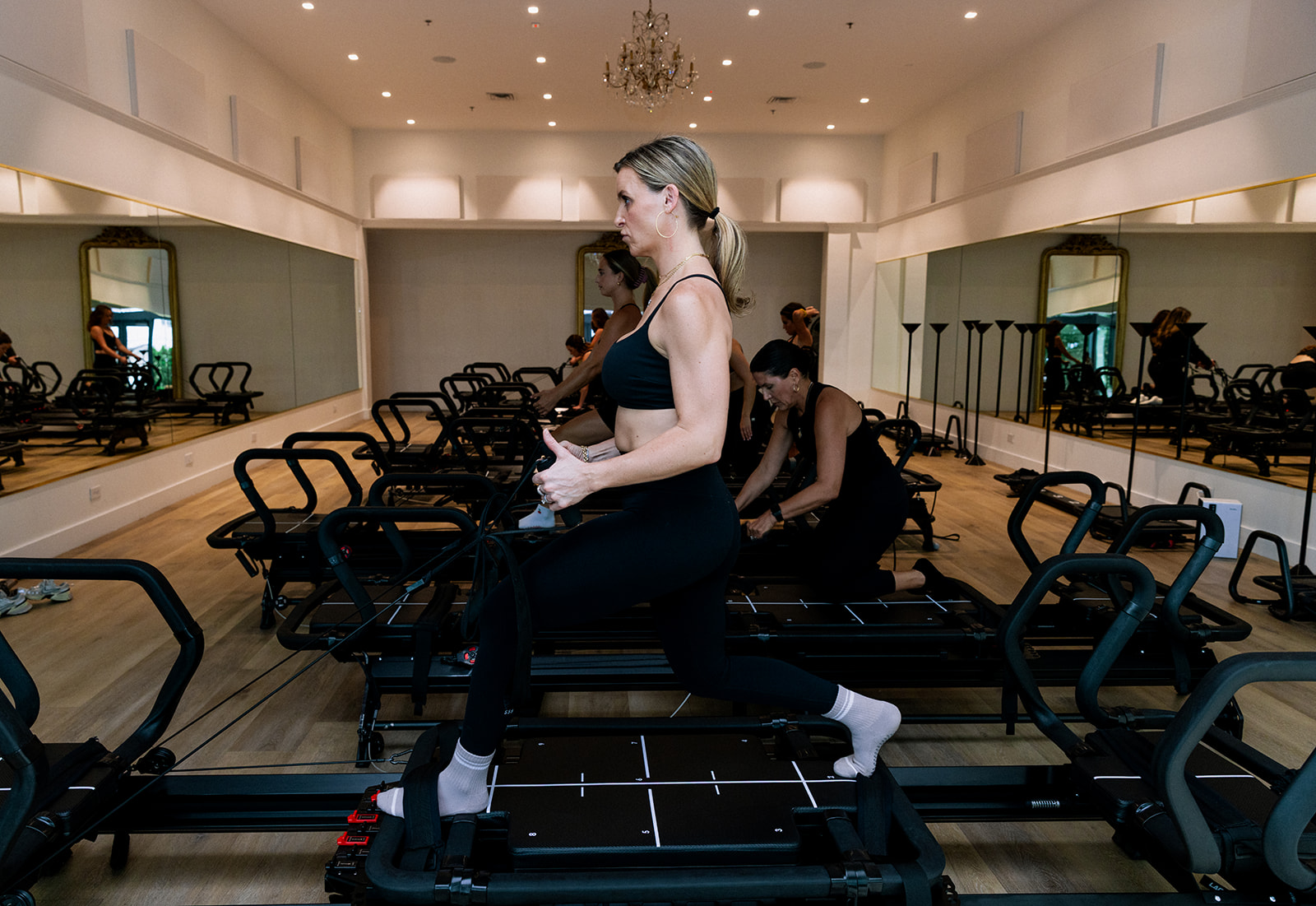
Lagree is a resistance-based method performed on the Megaformer. Heavy spring resistance, bodyweight, and slow controlled movement keep muscles under continuous tension throughout a 45-minute class. The tempo is strict: two seconds in each direction, no momentum, no rest between reps. Exercises run for 45 to 90 seconds before transitioning. The class hits every major muscle group, often simultaneously, with an emphasis on the core, glutes, legs, and upper body.
The primary mechanism in Lagree is time under tension. Muscles are kept working continuously for longer periods than almost any other training format achieves, which drives muscle fiber recruitment, endurance adaptation, and over time, lean muscle development. Lagree is low impact: nothing in the method involves jumping, heavy spinal loading, or repetitive joint stress. The Megaformer absorbs the forces that would otherwise travel through the knees, hips, and ankles.
The Fat Loss Question
This is where the comparison gets more nuanced than most fitness content admits. Fat loss is driven primarily by caloric deficit over time. The workout that helps you create the largest sustainable deficit is the one that produces the best fat loss results. That depends on three things: calories burned during the session, calories burned after the session through EPOC, and the effect on resting metabolic rate through muscle development.
During the session: A vigorous HIIT class typically burns more calories in the moment than a Lagree class. A 45-minute HIIT session might burn 400 to 600 calories for an average person. A Lagree class runs closer to 300 to 450.
After the session: HIIT produces a meaningful EPOC effect, continuing to burn calories for several hours. Lagree also produces an EPOC effect, and research on resistance-based methods suggests it may be more sustained even if the peak is lower.
Resting metabolic rate: This is where Lagree changes the equation significantly. Lean muscle tissue burns more calories at rest than fat tissue. HIIT does not build significant lean muscle. Lagree does. Over months of consistent training, the muscle development from Lagree raises the baseline number of calories the body burns every day, independent of any workout. Over six months or a year of consistent training, that difference compounds into meaningful results that pure cardio-based training does not produce.
What Each Method Builds
HIIT builds cardiovascular fitness, improves endurance, and burns calories efficiently. Done well it also develops some functional strength, particularly in lower body movements if those are part of the format. It is excellent for people whose primary goal is cardiovascular health or who thrive in high-exertion interval work.
Lagree builds lean muscle across the entire body, improves core strength dramatically, develops muscular endurance, and produces visible changes in muscle tone and definition. It also improves posture, stability, and the kind of deep core strength that carries over into daily life. The physical changes from consistent Lagree training are typically more visible and more lasting than those from HIIT alone.
The Longevity Question
This is the part of the HIIT conversation that does not get enough attention. HIIT is high impact. Burpees, jump squats, box jumps, sprint intervals: these movements load the joints, connective tissue, and spine repeatedly and at speed. For young, healthy people with no existing issues, that load is manageable. For people in their late 30s and beyond, or anyone with knee, hip, or lower back history, the cumulative effect of regular high-impact training adds up in ways that show up gradually and then suddenly.
Research published in the Journal of Sports Medicine and Physical Fitness analyzed nearly 4 million injuries resulting from HIIT-related exercises over a 10-year period, with a steady increase of roughly 50,000 additional injuries per year as HIIT grew in popularity. Most injuries involved knees, ankles, and shoulders. Lagree produces equivalent or greater muscular intensity with none of that impact. People with existing joint issues, people returning from injury, and people who simply want to train hard without accumulating damage can do Lagree in a way that sustained high-impact HIIT does not support long-term.
Can You Do Both?
Yes, and for many people the combination works well. HIIT develops cardiovascular capacity that makes Lagree more sustainable. Lagree builds the muscle and core strength that makes HIIT safer and more effective. If you are currently doing HIIT several times a week and wondering why your body composition has not shifted the way you expected, adding two Lagree sessions per week is one of the most impactful changes you can make. The muscle development from Lagree changes the metabolic picture in a way that pure cardio training cannot. The mistake is treating either method as the complete answer.
The Bottom Line
If your primary goal is cardiovascular fitness and you enjoy high-exertion sessions, HIIT is a good fit. If your primary goal is changing the way your body looks and feels, building visible muscle, improving core strength, and doing it in a way that does not accumulate joint damage over time, Lagree does more of that work per session. The results from two to three Lagree sessions per week, maintained consistently for two months, tend to answer the question more convincingly than any comparison article can.
About FORM Charleston
FORM Charleston runs 45-minute Lagree classes at two locations: 320 Broad Street downtown and 725 Coleman Boulevard in Mount Pleasant. Class sizes are small, instructors are certified, and the first-timers page covers everything you need to know before booking.
See what a different stimulus does for your body. Book at formcharleston.com.
Disclaimer: Calorie estimates are approximate and vary by individual. This content is for informational purposes only and does not constitute medical or dietary advice. Consult a qualified professional before changing your fitness regimen.