
.svg)

Why I Stopped Running and Started Lagree (And What Happened Next)
When Running Stops Working
For a long time, running was the answer to everything. Bad day at work? Go for a run. Need to clear your head, manage your weight, feel like you are doing something good for your body? Run. I ran for years. Not competitively, not obsessively, just consistently. Four or five times a week, between three and six miles depending on the season and my motivation. I knew the routes around my neighborhood by heart. I tracked my pace. I had opinions about running shoes. And for a long time, it worked. Until it did not.
Three Signs the Method Had Stopped Serving Me
The first sign was the plateau. After the first year or two of running regularly, my body stopped changing. The initial results had leveled off. I was putting in the same miles, the same effort, and getting the same body I had had for two years. This is a documented phenomenon and not a personal failing. The body adapts to repetitive cardiovascular exercise relatively quickly. Once it has adapted, it becomes efficient at the movement, which means burning fewer calories doing the same work.
The second sign was my knees. Nothing dramatic happened. No single injury, no moment of crisis. Just a gradual accumulation of tightness and achiness that started showing up on longer runs and eventually on shorter ones too. My left knee first. Then my right hip. Then my lower back on mornings after a hard effort. I ignored it for longer than I should have, the way most runners do, because running had become part of my identity.
The third sign was what running was not doing. I was lean in some ways but I had no upper body strength. My core was weak in the functional sense, meaning decent endurance but no real stability or definition. My posture was deteriorating. I was doing hours of exercise every week and the results had stopped reflecting that effort.
Finding Lagree
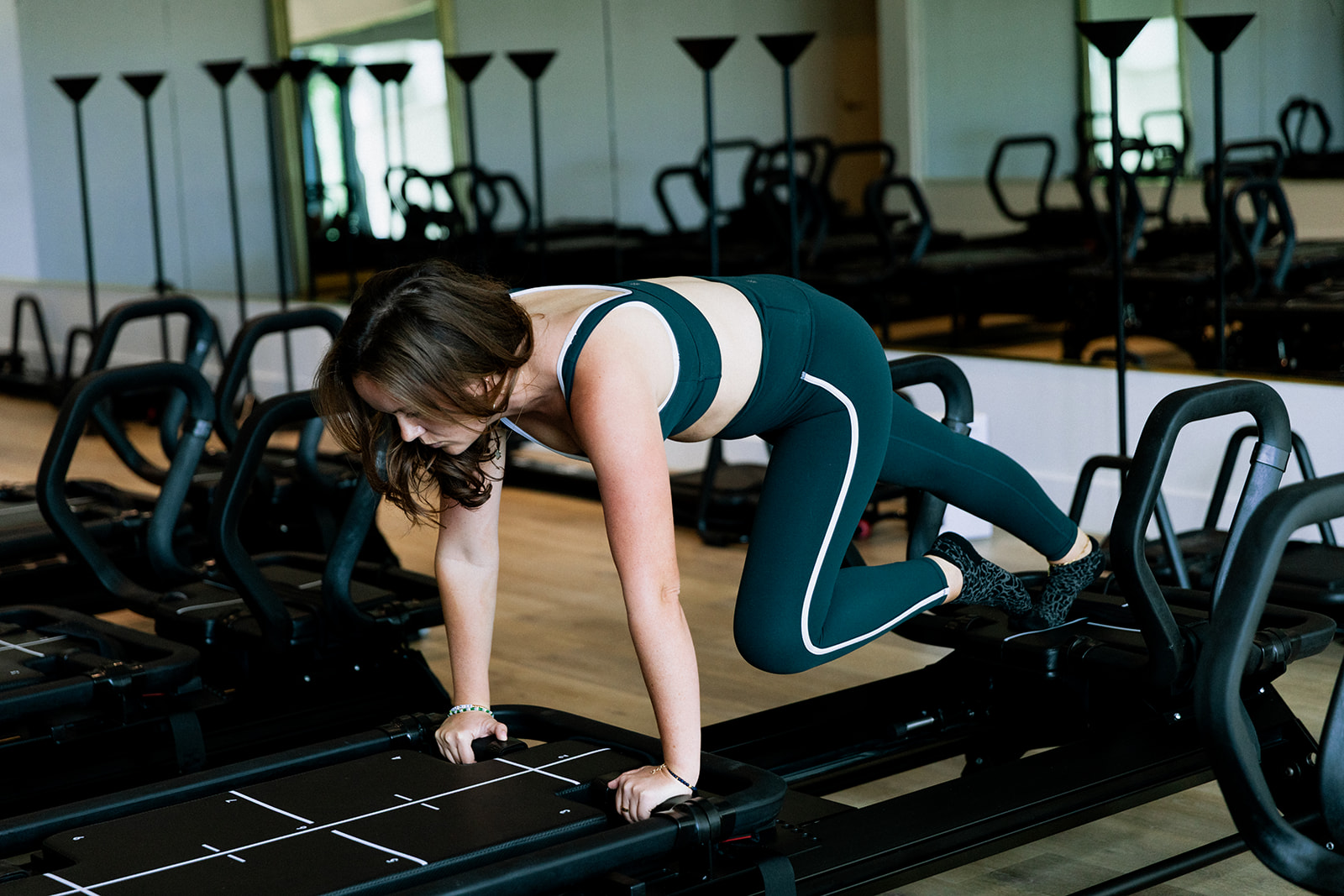
A friend mentioned it first. She had been going to FORM in downtown Charleston for a few months and kept describing it in ways that sounded implausible. Full body workout. Forty-five minutes. Low impact. Shaking by the second exercise. I was skeptical in the way that runners tend to be skeptical of anything that does not involve covering distance. How hard could it be if there was no running involved? How much could change in 45 minutes on a machine? I booked a first-timer class mostly to prove a point. I did not prove the point I was intending to prove.
By the third exercise I was shaking. By halfway through the class my legs were doing something I had never experienced in years of running: a deep, sustained muscular fatigue that had nothing to do with cardiovascular effort and everything to do with the muscle itself being pushed past its limit. I finished the class, walked carefully to my car, and sat in the parking lot for a few minutes collecting myself. I was sore for three days. In my inner thighs, my lateral core, the muscles around my shoulder blades, places that years of running had never touched. I booked another class before the soreness faded.
What Changed in the First Month
I kept running for the first few weeks after starting Lagree, partly out of habit. I would do a run in the morning and a Lagree class later in the week and try to hold both things at once. The running started to feel different. Not worse exactly, but less necessary. The hunger for it, the feeling that I needed to get out and cover ground to feel okay, started to ease. Partly because Lagree was satisfying something the running had not been: a real physical challenge that produced visible and felt results quickly.
Within the first month, my core was noticeably stronger. Not visibly different yet, but functionally different. I was standing straighter without thinking about it. My lower back, which had been a quiet source of discomfort for years, stopped bothering me. The hip tightness that had become a fixture of my running life started to ease because I was no longer loading my joints the same way every day. My legs changed shape. Less stringy, more defined. The glutes in particular, which running does almost nothing for in terms of muscle development, started to respond in a way I had not seen before.
Three Months In
By month three I had stopped running almost entirely. Not as a deliberate decision but as a natural drift. I was going to FORM three times a week and walking regularly, and I did not miss the miles the way I had expected to. The physical changes by this point were significant enough that people were noticing. My arms had definition I had never had from running. My waist had changed. The overall shape of my body was different in a way that felt more like what I had been trying to achieve for years.
My knees felt better than they had in years. The left knee that had become a constant low-level concern had quieted down almost completely. I was spending less total time working out and seeing better results. Three 45-minute Lagree classes per week compared to the four or five hours of running I had been doing. The efficiency gap was significant.
What Running Gets Right
This is not a case against running. Running is genuinely good for cardiovascular health, mental clarity, and the kind of meditative rhythm that many people, myself included for a long time, find nowhere else. If you love running and your body handles it well, keep running. The cardiovascular conditioning, the outdoor time, the simplicity of lacing up and going: those things have real value and they should not be dismissed.
What running is not, and what I needed it to be for too long, is a complete fitness solution. It does not build meaningful upper body strength. It does not develop the core in any deep way. It does not produce the kind of body composition changes that resistance-based training produces. And for many people, done at high frequency over years, it accumulates joint stress that shows up gradually. Lagree filled the gaps that running left. For someone else the gaps might be different. But if you are a runner who has plateaued, whose body has not changed in years despite consistent mileage, who has started to feel the wear in your knees or hips, it might be worth finding out what your body does with a completely different stimulus.
Where to Start
FORM Charleston has two locations. Downtown at 320 Broad Street inside The Jasper. Mount Pleasant at 725 Coleman Boulevard. Classes are 45 minutes. The first-timers page on their website covers everything you need to know before booking. Go in with an open mind. The machine will take care of the rest.
Curious what your body does with a different stimulus? Book at formcharleston.com.
Disclaimer: Individual experiences vary. This article reflects personal experience and is not medical advice. Consult a healthcare professional before changing your fitness routine.