
.svg)

How Lagree Changes After the First Month: What to Expect at Every Stage
The First Class Is Its Own Experience
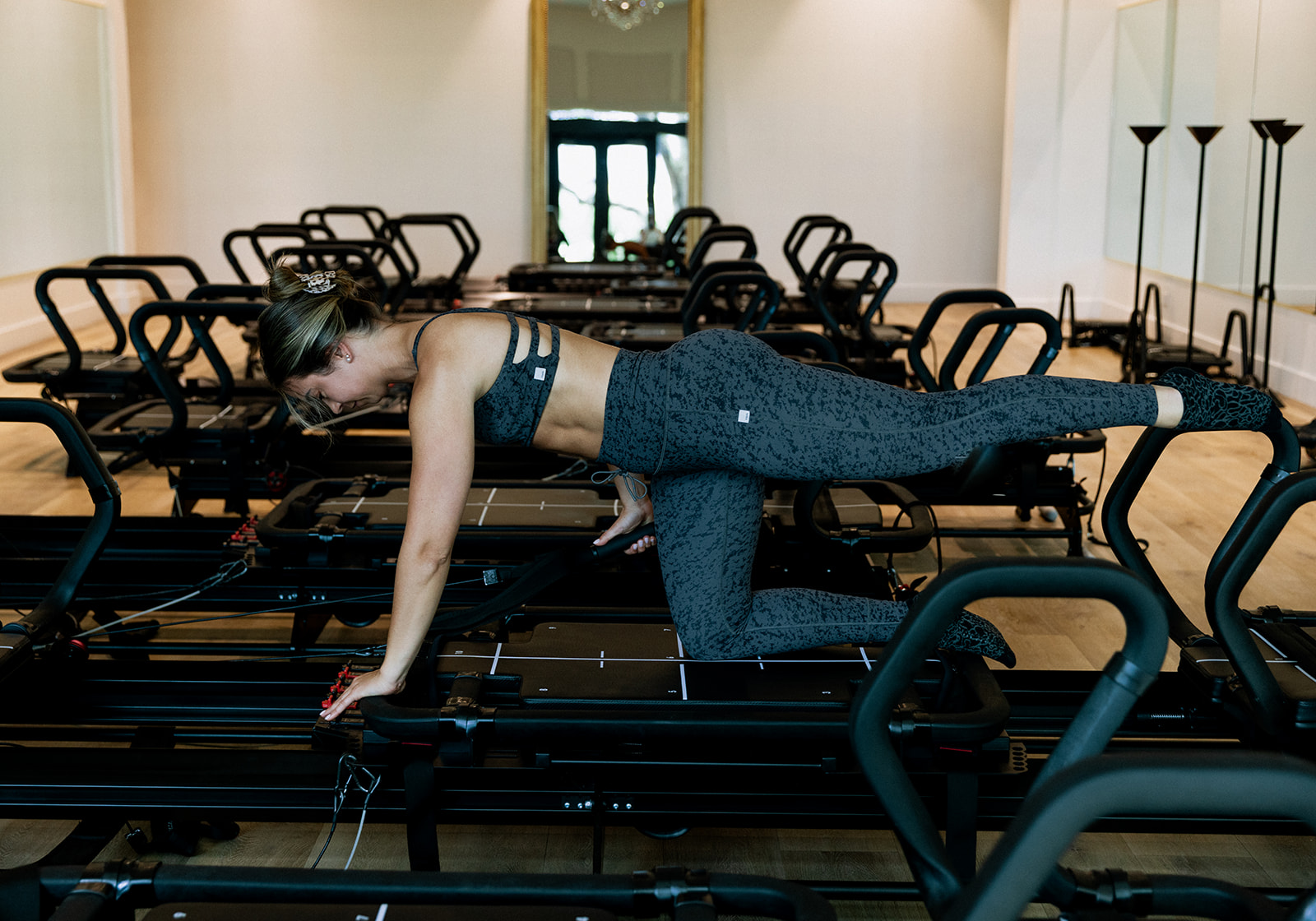
There is almost no way to fully prepare for a first Lagree class. You can read about it, watch videos, and ask people who have done it. None of it quite captures what it actually feels like to be on the Megaformer for the first time, moving at a tempo that feels impossibly slow, trying to coordinate spring resistance with body position while your legs begin doing something involuntary and somewhat alarming. Most first-timers describe it later with some combination of humility and surprise.
The physical response is significant. The delayed onset soreness that arrives 24 to 48 hours afterward tends to be deep, specific, and felt in places that other workouts have never touched: inner thighs, the small muscles around the shoulder blades, the lateral core, the deep glutes. This is useful information about which fibers were recruited and how hard they worked. It can also be alarming enough that some first-timers wonder whether they should go back. They should go back.
The First Month: Learning the Machine
The first month of Lagree is really about two things happening simultaneously: learning to use the Megaformer correctly and allowing the body to adapt to a training stimulus it has not encountered before.
The technique learning curve is real. Lagree has a specific tempo, a specific approach to body position, and a specific requirement for where the work should be felt. In the first several classes, most of the mental energy goes toward understanding what the instructor is describing, finding the correct position, and making adjustments based on feedback. This is normal. Every experienced Lagree client moving smoothly through a class was confused and shaky in their first few weeks too.
The physical adaptation during the first month is aggressive. The body is encountering sustained time under tension at a depth it has not experienced before, and it responds accordingly. Soreness between sessions is common in weeks one and two. By weeks three and four, the soreness typically becomes more manageable and recovery becomes faster. Strength gains in this phase are partly neurological, as the nervous system gets better at recruiting the correct muscle fibers, and partly structural. Both are happening quickly.
Months Two and Three: The Results Start Showing
This is the window where most people notice things changing in visible and felt ways. By the second month, the soreness from each class has usually become the satisfying kind rather than the disruptive kind. Recovery between sessions is faster. The exercises that felt impossible in week one are now manageable, though still demanding in the way Lagree always is.
Postural changes tend to become apparent around this point. People find themselves standing straighter without trying to. Shoulders sit differently. The core holds the spine in a more organized position as a default rather than a deliberate effort. Partners, colleagues, and friends often notice before the person training does.
Body composition changes are visible by month three for most people training two to three times per week. The changes are different from what cardio training produces. Lagree builds lean muscle throughout the entire body simultaneously: the legs, glutes, core, back, and arms. The result is more definition, more density, a different shape rather than simply a smaller version of the same shape. This is because lean muscle tissue is being developed, not just calories being burned during the session.
Months Three to Six: The Compound Effect
The most meaningful changes in Lagree training are not the dramatic ones from the first few weeks. They are the ones that accumulate across months of consistent practice. By the three to six month mark, something has shifted in the underlying structure of the training.
The exercises that once required maximum effort to complete are now completing with capacity to spare, which means the instructor's spring adjustments and technique refinements start producing real differences in training intensity. The range of exercises you can perform well has expanded. The Megaformer starts to feel less like something that is happening to you and more like something you are directing. That shift in agency changes how much you get from each class.
The structural changes to muscle density and body composition that are driving postural improvement continue to compound. Muscle built in month two is still there in month six, doing its metabolic work, supporting the load from subsequent sessions. This is the key difference between Lagree and cardio-only training: the adaptations do not disappear when you miss a week. They accumulate.
Lagree results are not linear. The visible changes from month two build on the structural changes from month one. Consistency over three to six months produces a cumulative result that no single session can reflect.
What Consistency Actually Looks Like
Two to three sessions per week is the number that produces meaningful, progressive adaptation for most people. Not because it is arbitrary, but because it is the frequency at which training stimulus and recovery time exist in the right balance. One session per week is better than none but typically insufficient to drive consistent compounding results. More than four sessions per week, for most people, introduces fatigue that undermines the quality of each session.
The clients who see the most significant changes from Lagree are almost never the ones who trained most intensely in any given week. They are the ones who showed up consistently over months. Three sessions per week for twelve weeks beats six sessions per week for four weeks, every time. Consistency is the mechanism. The workout takes care of the rest.
Frequently Asked Questions
When do you see results from Lagree?
Functional changes, including improved core stability and posture, are typically felt within 3 to 4 classes. Visible body composition changes, including muscle definition and shape, appear for most clients between weeks 6 and 12 with 2 to 3 sessions per week.
Does Lagree get easier over time?
The method stays challenging because spring resistance and exercise variations are adjusted as you progress. What changes is your capacity. By month two, the exercises that exhausted you in week one are now completing with room to push harder.
How many times a week should I do Lagree to see results?
2 to 3 times per week is the optimal range for most people. This provides enough training stimulus to drive consistent adaptation while allowing adequate recovery time between sessions.
About FORM Charleston
FORM is a women-owned, certified Lagree Fitness studio running 45-minute classes on the Megaformer at two Charleston locations. Downtown at 320 Broad Street, and in Mount Pleasant at 725 Coleman Boulevard. The first-timers page on the FORM website covers everything before your first session.