
.svg)

What Slow Actually Means in Lagree (And Why It Is the Hardest Part)
Nobody Expects Slow to Be the Challenge
When most people imagine a hard workout, they imagine speed. Fast reps. Heavy weight moved quickly. Sprint intervals. The association between effort and pace is so deeply embedded in how most people think about exercise that slow movement sounds like a modification for beginners, not a method for serious training.
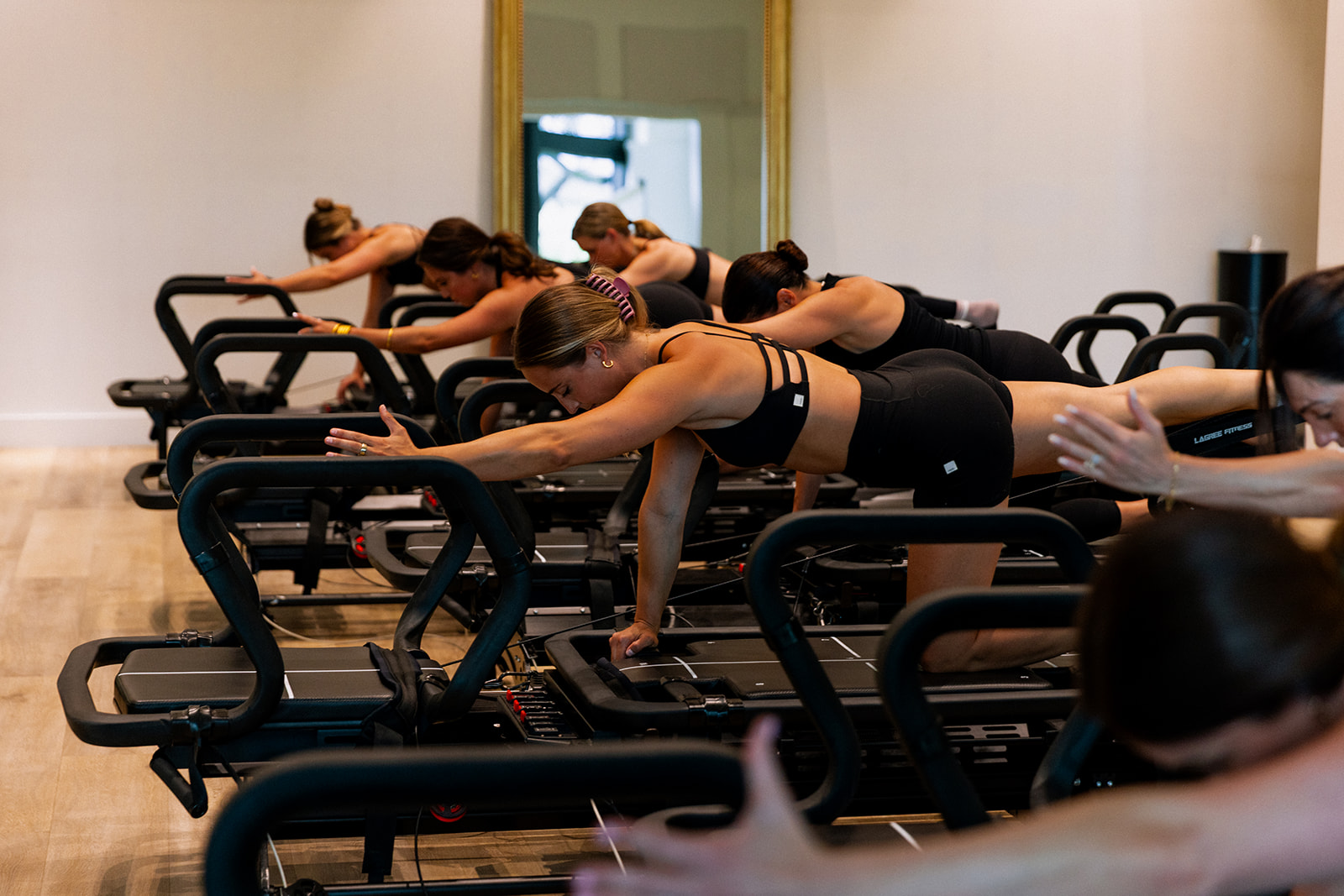
The first time someone gets on a Megaformer and tries to move at Lagree tempo, two seconds in each direction with continuous resistance and no momentum, they realize almost immediately that their intuition was wrong. Slow is not easier. Slow is the mechanism. It is the reason Lagree produces the muscular fatigue it produces, and it is the part of the method that most new clients have to actively concentrate on maintaining as the session progresses.
The Physics of Why Slow Works
Muscles under continuous tension fatigue differently than muscles used in brief, explosive movements. When you move quickly through a range of motion, momentum takes over at the midpoint of most fast movements. This means the muscle is actually unloaded briefly during the rep. The joint and tendon bear the force at the end range. This is how most conventional resistance training works, and it is effective for building maximum strength.
Lagree operates on a different principle. At a two-second tempo with constant spring resistance, momentum is eliminated entirely. The muscle is generating force throughout the entire range of motion, without a break at any point in the rep. This sustained tension recruits a broader spectrum of muscle fibers, particularly the slow-twitch fibers responsible for muscular endurance, which are less responsive to explosive movement. It also keeps the muscle in metabolic stress for longer, through the accumulation of metabolites like lactate and hydrogen ions, which is one of the primary drivers of muscle adaptation.
Time under tension is the key variable. Lagree maximizes it by removing momentum entirely. Each set runs for at least 60 seconds at strict tempo, stimulating both slow-twitch and fast-twitch muscle fibers simultaneously. That is why 45 minutes on a Megaformer produces more total muscular stimulus than most hour-long gym sessions.
What the Shaking Means
The shaking that new clients experience, and that experienced ones continue to experience in challenging exercises, is the neuromuscular system running out of available motor units and recruiting additional ones to maintain the required force output at the required tempo. It is not a sign that something is wrong. It is the mechanism working as intended. The slow-twitch fibers responsible for sustained endurance are being pushed past their comfort zone, which is exactly where adaptation happens.
Understanding this changes how you relate to it. The shaking is not something to push through by gripping harder or holding your breath. It is something to relax into while maintaining the tempo. The instructor will cue this throughout class: "stay slow," "control the carriage," "do not let momentum take over." Those cues are not reminders. They are the entire method.
What Makes the Tempo Hard to Maintain
The tempo in Lagree is not a suggestion. It is the method. Moving too fast undermines the time under tension that produces the stimulus. But when muscles are deeply fatiguing during a 60 to 90 second set, the instinct to speed up, to use momentum, to find any way to reduce the sustained muscular effort, becomes very strong. Managing that instinct is the skill that separates a productive Lagree session from a less effective one.
This is not about willpower. It is about body awareness. The body will find ways to cheat the tempo that are subtle enough that the person doing them does not always notice: a small rotation of the hip to redirect the load, a slight speed increase at the midpoint, a momentary pause at the end range. Each of these reduces the effectiveness of the movement. Learning to feel the difference between controlled slow movement and compensated movement is most of what the technique learning curve in Lagree is actually about.
The Spring Resistance Layer
The Megaformer uses spring resistance, which means the load changes slightly across the range of motion as the springs compress and extend. This is different from free weight resistance, which is constant. Spring resistance at Lagree tempo means the muscle is managing a changing load while also maintaining a strict pace, which adds coordination demand on top of the strength and endurance demand. The instructor adjustments to spring settings throughout a class are calibrated to make the tempo sustainable but not easy. Heavy enough that rushing through the difficult part of the range is not a viable option. Light enough that the movement is controllable.
The Focus Dimension
There is a focus requirement to Lagree that is different from most other workout formats. High-intensity classes rely on exertion so extreme that thinking is not really possible. Running and cycling allow the mind to wander, which is part of their appeal. Lagree requires sustained attention to body position, tempo, and where the effort is being felt for 45 minutes. That attention is part of what makes it effective. When your attention is fully in the muscle that is working, at the pace it needs to work, the neuromuscular connection that drives adaptation is reinforced in ways that distracted movement does not produce.
Experienced practitioners often describe Lagree as meditative in the specific sense that the body fully occupies the mind during class. There is nothing left over for the to-do list or whatever was on your phone five minutes ago. That quality of attention, sustained for 45 minutes of full-body effort, is something most people have not encountered in a workout before. It is part of what makes people come back.
Frequently Asked Questions
What is the tempo in a Lagree class?
Two seconds in each direction, throughout every exercise for the entire class. There is no variation. The consistent slow tempo eliminates momentum and keeps muscles under continuous tension for the full duration of each set.
Why do people shake in Lagree?
Shaking occurs when the neuromuscular system recruits additional motor units to maintain force output as fatigue sets in. It indicates the slow-twitch muscle fibers are being pushed past their comfort zone, which is exactly where endurance adaptation happens.
What is time under tension and why does it matter?
Time under tension refers to how long a muscle is actively working during a set. Longer time under tension drives greater muscle development and endurance than shorter bursts of higher effort. Lagree is designed specifically to maximize this variable by eliminating momentum and using sustained resistance for 45 to 90 seconds per exercise.
About FORM Charleston
FORM is a certified Lagree Fitness studio with two locations in Charleston, SC. Downtown at 320 Broad Street, and Mount Pleasant at 725 Coleman Boulevard. Classes run 45 minutes. Small groups. Certified instructors who cue tempo and position throughout every class.